sensors.social Roadmap — April & May 2026
With the Altruist sensor platform and tools for building environmental monitoring networks in place, we're pushing the project forward in four directions over the next two months.
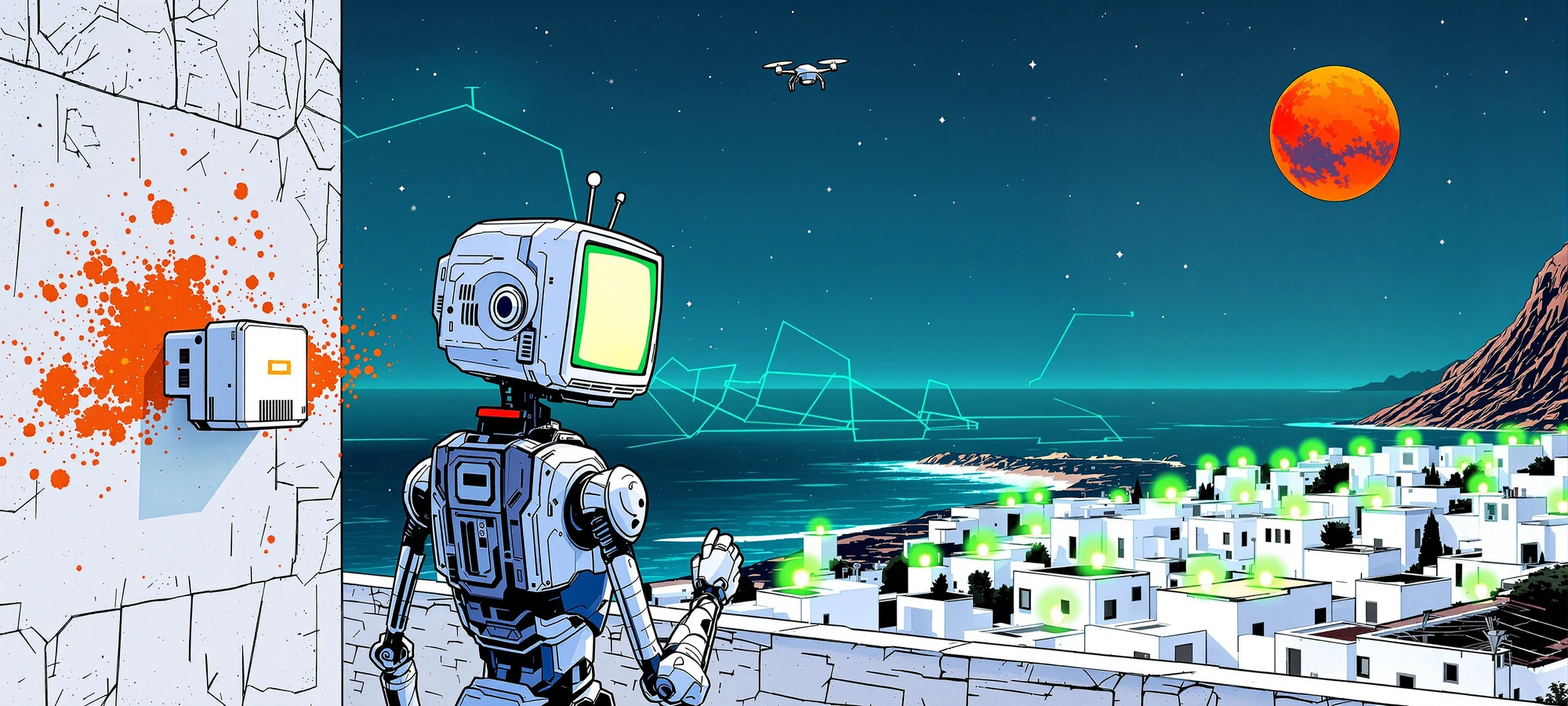
With the Altruist sensor platform up and running and tools for building environmental monitoring networks already in place, we’re spending the next two months pushing the project in four directions.
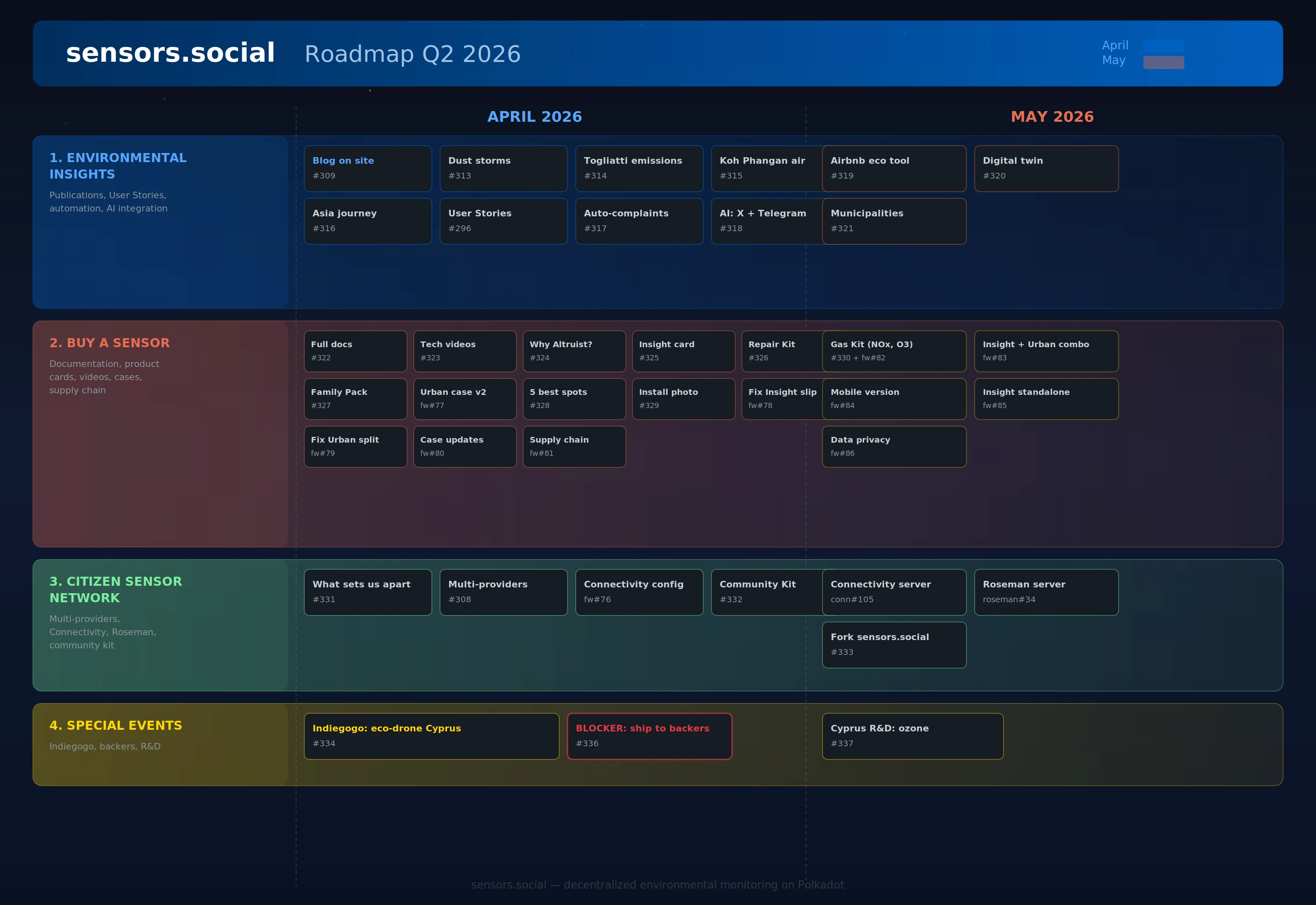
1. Environmental Insights
The data our sensors collect is only valuable if people can understand and act on it. This spring we’re launching a blog directly on sensors.social — a home for environmental reports that matter. The first wave of publications will cover the dust storms that recently hit Cyprus, industrial emissions patterns in Togliatti captured by citizen sensors, air quality on Koh Phangan during burning season, and a travelogue of Altruist sensors deployed across Asia.
Beyond one-off reports, we want sensors.social to tell continuous stories. A new User Stories section will appear in the site header — short personal commentaries alongside real sensor readings, giving the data a human voice. On the automation side, we’re wiring up our X account and Telegram bot to Roseman so that environmental events — dust spikes, emission anomalies — trigger posts and alerts without anyone pressing a button. The same pipeline will generate complaint letters to environmental authorities when thresholds are breached.
By May the focus shifts to practical tools. Airbnb hosts will be able to prove their apartment’s ecology with graphs pulled straight from nearby sensors. We’re building a digital twin feature — a 6 to 12 month environmental profile of a living space that can genuinely increase property attractiveness. And for municipalities, a dedicated section enabling citizen-powered monitoring of construction site dust and noise.
2. Buy a Sensor
Altruist works, but buying one and setting it up should be effortless. In April we’re writing complete documentation for all three device variations, producing technical video guides covering installation and daily use, and creating a content series answering the question every potential user asks — “why do I actually need this?”
The product line is expanding too. Insight becomes available as a standalone indoor sensor. A Small Repair Kit under $30 lets owners replace worn components themselves. The Family Pack bundles two Urbans and two Insights for full indoor-outdoor coverage. Meanwhile we’re designing an alternative utilitarian Urban case for those who prefer function over form, and fixing the two most common hardware complaints — Insight sliding on smooth surfaces and Urban case halves separating over time.
In May we go deeper. A gas analysis add-on kit brings NOx and O3 sensing to Urban. We’re prototyping a combined Insight+Urban — a single indoor air quality device competing with the likes of Qingping. Both Urban and Insight get mobile versions powered by standard USB power banks. The big swing: Insight standalone firmware that works offline without Urban as a base station, turning it into a direct Aranet4 Home competitor with an Amazon listing as the target. And new privacy features give users more control over how their sensor data is stored and shared.
Behind the scenes, we’re reorganizing the supply chain with proper component inventory tracking on the warehouse side.
3. Citizen Sensor Network
sensors.social isn’t just a map — it’s becoming a federated infrastructure. In April we’re publishing an article explaining what makes our approach different from centralized sensor networks, and backing it up with a concrete feature: multi-provider support on the map, so the network isn’t locked to a single data source. Firmware gets configurable connectivity options, letting device owners choose where their data flows.
We’re also assembling the Community Kit — pre-configured single-board computers running Connectivity and Roseman, ready for groups who want to deploy their own local sensor network.
By May, both Connectivity and Roseman ship as standalone server products with documentation and Docker images. And the final piece: a fork-and-deploy service for communities that want to run their own sensors.social instance with custom branding and local data.
4. Special Events
We’re preparing an Indiegogo campaign for a summer project — eco-drone adventures in Cyprus, monitoring water quality at beaches and reservoirs. Before that can launch, every past backer needs to have received their Altruist sensor, which is the hard blocker we’re working against in April.
In May, we kick off a research project studying elevated ozone levels in Cyprus.
Track our progress on the GitHub project board.