
Robonomics release 51: governance goes to XRT holders, CPS gets Scope and Access
What is in runtime 51, what changes for integrators, and what comes next. EnsRationis [Robonomics Software Architect]
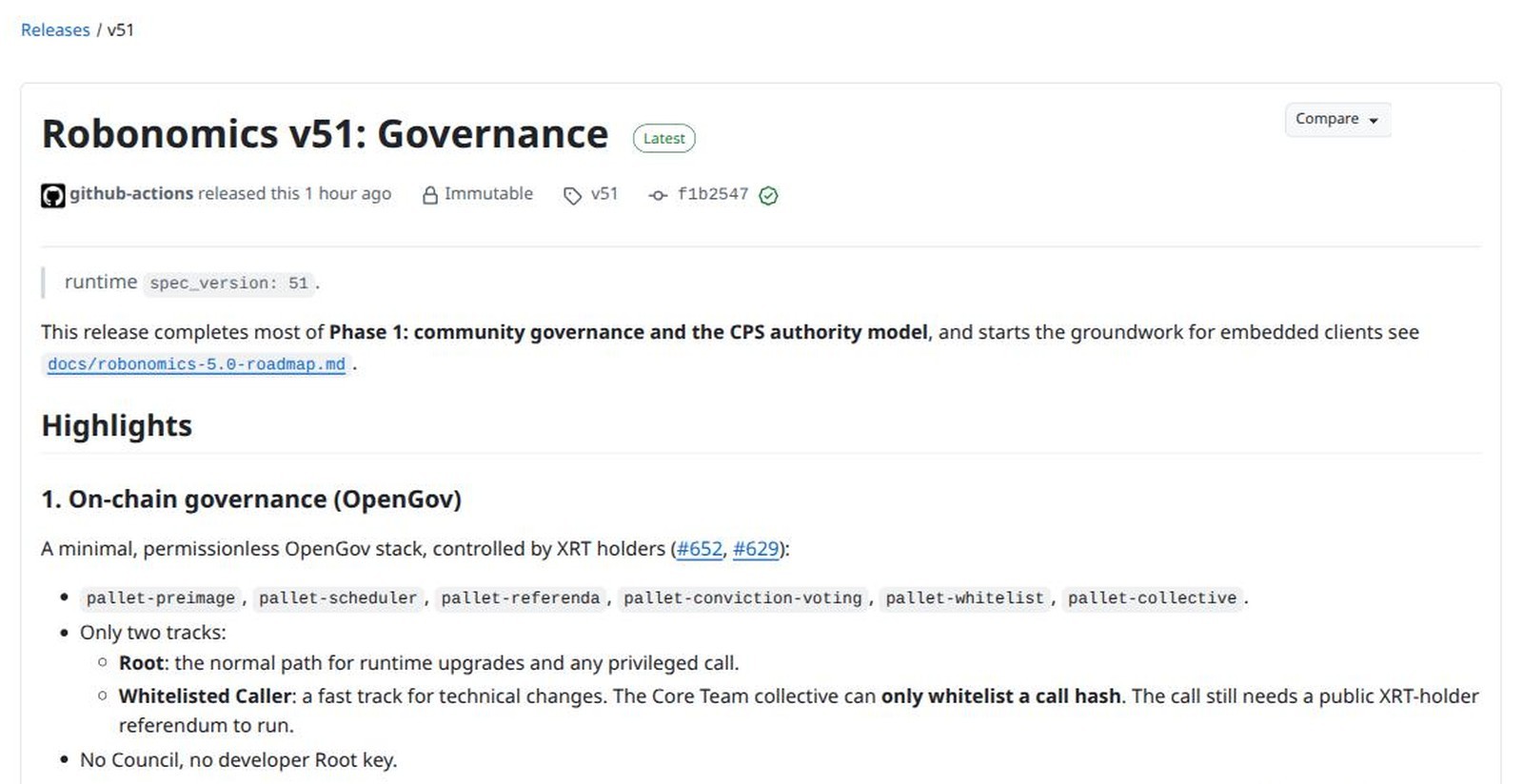
Release 51 “Governance” is out. It completes most of Phase 1 of the Robonomics 5.0 roadmap: community governance and the authority model for cyber-physical systems (CPS).
Status: runtime 51 is built and published, but not enacted yet. The Robonomics parachain on Polkadot runs spec version 50.
OpenGov, controlled by XRT holders
This is the stack announced in Robonomics 5.0: governance, now in a release (#652). It is standard Polkadot OpenGov, sized for a small community, with two tracks only:
- Root is the normal path for runtime upgrades and any privileged call.
- Whitelisted Caller is a fast track for technical changes. The Core Team collective can only whitelist the hash of a call. The call still needs a public referendum of XRT holders to run.
There is no Council and no developer Root key.
This is stage A of the handover. Sudo remains only as a recovery path. The next step is a runtime upgrade that removes Sudo, submitted and enacted through OpenGov itself (#633).
CPS v1.0: Scope and Access
The CPS pallet moves from per-node owners to the Scope / Access model (#653).
- A Scope is the administrative and economic boundary of a subtree: a building, a fleet, a customer. A node belongs to its nearest Scope ancestor. A nested Scope is a hard boundary for authority and, later, for resource accounting.
- Access delegates rights inside one Scope:
Writechanges a node’s data,CreateScopecreates a Scope or hands over control. A grant covers one node or a whole subtree, and never crosses a nested Scope. - A node’s parent never changes. To move a node, create a new one and delete the old one.
- Changing the owner starts a new Scope generation. A fresh Scope ID is allocated and all old grants stop working immediately. There is no transfer/accept flow.
- Fees follow data size. Node metadata is limited to 1 KiB and payload to 8 KiB.
- One call gives the effective owner.
CpsApi::resolve_scope(node)returns the Scope, its root and its owner through the standard runtime API. No custom RPC is needed.
For embedded clients
Runtime metadata now lives in a separate crate, robonomics-runtime-metadata (#665). It is the single source for all API generators: the Rust subxt-api today, and the embedded embed-api next.
The engineering baseline also got stricter: every extrinsic must be charged through benchmarked weights (checked in CI), try-runtime is mandatory whenever a storage version changes, and a local development chain now starts with polkadot-omni-node --dev and no extra binaries.
Upgrade notes
The CPS changes are breaking:
move_node,transfer_ownership,accept_ownershipanddelete_scopeare removed.resolve_ownershipis replaced byresolve_scope. Clients andlibcpsshould get the owner through it instead of walking the parent chain.- Metadata above 1 KiB and payload above 8 KiB are rejected.
subxt-apinow needs subxt 0.51. For metadata, depend onrobonomics-runtime-metadata.
After the upgrade is enacted, runtime upgrades go through Root or Whitelisted Caller referenda.
What comes next
The next release removes Sudo through OpenGov and brings Subscription with Scope-funded transactions: a device owned by a Scope will send its first transaction without holding XRT, and the owner pays.
Full release notes: github.com/airalab/robonomics/releases/tag/v51. Discussion on the Polkadot forum: Robonomics: replacing Sudo with a two-track OpenGov.
 — EnsRationis, Robonomics Software Architect · https://x.com/EnsRationis